
When chronic pain settles into your lower back, shoulders, hips, and legs, the conventional search for relief often feels like a frustrating game of whack-a-mole. You might try deep tissue massages or physical therapy exercises, only to find the same persistent ache returning a few days later. The reason for this cycle often lies in a simple misunderstanding: treating the site of pain rather than addressing the structural imbalance causing it. Enter Rolfing Structural Integration, a specialized form of structural bodywork designed to organize the human body in gravity. Rather than focusing solely on isolated sore muscles, Rolfing addresses the body’s interconnected connective tissue network, offering lasting relief for individuals struggling with chronic discomfort and restricted movement.
Understanding the Role of Fascia
To understand how Rolfing works, you must first understand fascia. Fascia is the continuous web of connective tissue that wraps around every muscle, bone, organ, nerve, and blood vessel in your body. Think of it as a form-fitting biological suit that holds your body in its three-dimensional shape. In a healthy state, fascia is elastic and slides smoothly as you move. However, factors like physical trauma, repetitive stress, poor desk posture, and emotional strain cause fascia to lose its flexibility. Over time, it thickens and glues itself into restrictive patterns.
When fascia tightens in one area, it pulls the rest of the body out of alignment, much like pulling a loose thread on a knitted sweater distorts the entire garment. A tight hamstring might pull down on your pelvis, which in turn strains your lower back and forces your neck muscles to overwork just to keep your eyes level with the horizon. Rolfing looks beyond the localized pain to identify and release these systemic fascial strain patterns.
What Makes Rolfing Different From Traditional Massage?
While both practices involve hands-on touch, Rolfing and traditional massage therapy serve very different purposes. Standard deep tissue massage primarily targets muscle relaxation and local blood circulation, offering immediate and temporary comfort. Rolfing, on the other hand, is a systematic process of somatic re-education and structural realignment. Through skilled manual manipulation and guided client movement, a certified Rolfer applies precise pressure to release fascial adhesions and restore balance across major joints.
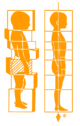
Furthermore, Rolfing places a heavy emphasis on how your body interacts with gravity. Gravity is a constant downward force acting on us every second of our lives. When your body is properly aligned, with your head, shoulders, thorax, pelvis, and feet stacked efficiently, gravity provides support and lift. When your structure is misaligned, gravity pulls you down, forcing your muscles to work twice as hard just to keep you upright, resulting in chronic fatigue and pain.
Targeted Pain Solutions
By realigning the fascial network, structural bodywork delivers targeted, long-term solutions for a wide array of chronic pain conditions that often fail to respond to localized treatments. For instance, chronic lower back and hip pain are frequently caused by tight hip flexors, such as the psoas muscle, pulling the lumbar spine forward. Rolfing releases deep pelvic and abdominal fascia, allowing the spine to decompress naturally.
Similarly, hours spent slouched over computers and smartphones cause chest fascia to shorten while straining upper back and neck muscles, a condition commonly known as tech neck. Rolfing opens the front of the ribcage, allowing the head and shoulders to rest effortlessly over the spine. Even foot conditions like plantar fasciitis benefit immensely, as restoring proper fascial tension through the calves and ankles resolves compensatory strain that travels upward into the knees and hips.
The Ten-Series Journey and Movement Re-education
Rolfing is traditionally experienced through a structured sequence of ten sessions, known as the Ten-Series. Rather than treating each visit as an isolated appointment, the Ten-Series is a comprehensive blueprint designed to systematically transform your entire body structure. The early sessions focus on the superficial layers of fascia, aiming to improve breath capacity and ease tension across the legs and torso. The middle sessions work deep within the pelvis, inner thighs, abdominal cavity, and neck to establish a stable structural core. Finally, the integration sessions coordinate the relationship between the core and your limbs, ensuring smooth, efficient movement throughout daily life.
Throughout this process, movement re-education plays a vital role. Your Rolfer helps you recognize and unlearn harmful movement habits, replacing them with effortless, balanced motion.
Reclaiming Comfort and Freedom of Movement
Living with chronic pain can make you feel disconnected from your own physical form. Rolfing offers a transformative pathway back to structural harmony. By freeing your fascia from historical strain and aligning your body with gravity, this specialized form of structural bodywork does not just manage your symptoms. It creates a resilient foundation for a lifetime of fluid, pain-free movement.
Start your treatment by reaching out today!
Frequently Asked Questions
How does Rolfing relieve chronic pain if it doesn’t focus directly on where it hurts?
Rolfing treats the root structural imbalance causing your pain rather than just soothing the painful symptom itself. Because fascia forms a continuous web throughout your entire body, a restriction in your hips or feet often pulls on connective tissue elsewhere, creating chronic strain in your lower back or neck. By releasing fascial tightness throughout these interconnected pathways, Rolfing eliminates the underlying tension pulling your body out of alignment, bringing lasting relief to the area that hurts.
Is Rolfing painful, and how does the pressure compare to deep tissue massage?
While Rolfing has a historical reputation for being intense, modern Rolfing Structural Integration emphasizes intelligent, sensitive pressure tailored to your body’s tolerance. Rather than forcing through tight tissues, a certified Rolfer works collaboratively with your breath and subtle movement to melt fascial restrictions. You may experience a sensation of deep, satisfying stretch or momentary intensity in areas of chronic tension.
How many Rolfing sessions will I need before I notice a reduction in pain?
While individual results depend on your history of injury and chronic strain, the traditional Rolfing Ten-Series is designed to systematically realign your entire structure over ten progressive visits. This structured approach ensures that initial pain relief converts into long-term structural balance and movement freedom.