

If you suffer from chronic back pain or persistent postural strain, you have likely explored various bodywork modalities to find relief. Among the most common recommendations are deep tissue massage and Rolfing™ therapy.
At a glance, both approaches involve hands-on manipulation of deep bodily tissues, leading many people to assume they are essentially the same service under different names. However, despite sharing some tactile similarities, Rolfing™ therapy and deep tissue massage differ in their fundamental philosophy and methodology. Understanding these distinctions is the key to choosing the right treatment for your body’s specific needs.
Understanding the Core Targets: Muscles vs. Fascia
To understand how these two modalities differ, it helps to look at the specific tissue each practice targets. Deep tissue massage primarily focuses on individual muscles and tendons. When you experience a localized muscle knot or spasm, which is often caused by acute strain or overuse, a massage therapist uses targeted pressure across the grain of the muscle fibers. The immediate goal is to encourage the tight muscle tissue to relax.
In contrast, Rolfing™ therapy (formally known as Rolfing™ Structural Integration) targets the fascia. Fascia is a continuous, web-like matrix of connective tissue that wraps around every muscle, bone, organ, nerve, and blood vessel in your body. Rather than viewing muscles as isolated units, Rolfing™ therapy views the body as an interconnected fascial network. When fascia becomes bound due to poor posture or past injuries, it pulls the skeletal structure out of natural alignment, forcing surrounding muscles to overwork to keep you upright.
Isolated Relief vs. Holistic Structural Integration
The main distinction between the two approaches lies in their overarching goals and scope of treatment. Deep tissue massage is largely symptom-oriented. If your lower back hurts, the therapist focuses on relaxing the muscles in your lower back. Rolfing™ therapy is systemic and holistic. A certified Rolfer™ recognizes that lower back pain might actually stem from restricted fascia in your feet, tight hip flexors, or an asymmetrical pelvis. By addressing structural misalignments across the entire body, Rolfing™treats the root cause of chronic discomfort rather than just soothing the surface symptom.
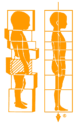
Furthermore, Rolfing™ therapy was specifically engineered around a core physical constant: gravity. Developed in the mid-20th century by biochemist Dr. Ida Rolf, this modality operates on the principle that when a body is misaligned, gravity acts as a destructive force, constantly pulling on compromised joints and strained muscles. Rolfing™ reorganizes the fascial web so that the body’s main segments (the head, shoulders, thorax, pelvis, and legs) stack vertically over one another, allowing gravity to support the structure rather than strain it. While deep tissue massage is typically received as a standalone, episodic treatment whenever you feel sore, Rolfing™ therapy is traditionally administered as a progressive, ten-session protocol designed to align the entire body from the feet up.
What to Expect During a Session
The physical experience during a session also varies significantly between the two practices. During a deep tissue massage, you typically lie passively on a massage table. At the same time, the therapist uses oils or lotions to glide over the skin, applying firm pressure to encourage physical and mental relaxation. The session is restful and focused on releasing conscious tension.
During a Rolfing™ therapy session, client participation is active and dynamic. You are often asked to perform small, precise movements, such as flexing an ankle or tilting your pelvis, while the practitioner applies slow, directional pressure to specific fascial planes. This active movement helps re-educate your nervous system, allowing your brain to update how it perceives and controls those movement patterns. Additionally, a Rolfer™ regularly assesses your posture while you are standing and walking to observe how your body adapts to gravity in motion.
Choosing the Right Modality for Your Body
Deciding between these two effective therapies ultimately comes down to your personal health goals. Deep tissue massage is the ideal choice if you are seeking localized stress relief, temporary relaxation, or immediate recovery from a recent workout or acute muscle spasm. It excels at periodic physical maintenance and short-term tension release. On the other hand, Rolfing™ therapy is designed for those dealing with chronic postural issues, long-standing movement restrictions, recurring sports injuries, or a desire to transform their overall posture and physical efficiency. By looking beyond temporary symptoms and addressing the body’s foundational structure, Rolfing™ therapy offers a transformative approach to movement and lifelong physical well-being.
Frequently Asked Questions
How does Rolfing™ Structural Integration differ from deep tissue massage in its overall goal?
While deep tissue massage focuses on relaxing specific, sore muscles and providing temporary stress relief, Rolfing™ therapy aims to realign and restructure the whole body in relation to gravity. Deep tissue treats isolated symptoms, whereas Rolfing looks at systemic patterns across the entire body to deliver long-term postural and structural changes.
What is the difference in the target tissue between the two therapies?
Deep tissue massage primarily targets individual muscles, tendons, and muscle knots to release localized tension and improve blood flow. Rolfing Structural Integration focuses on the fascia, which is the continuous, web-like connective tissue network that wraps around muscles, bones, and organs. Rolfing™ reorganizes it to relieve structural strain across entire movement chains.
Is client participation required during a Rolfing™ session compared to a massage?
Yes. During a deep tissue massage, clients remain passive on the table to promote maximum physical relaxation. In a Rolfing™ session, clients participate actively by performing subtle movements, such as flexing a joint or standing and walking, to help retrain the nervous system and lock in new movement patterns.
How do the treatment plans and session structures differ?
Deep tissue massage is usually received as an episodic, stand-alone session whenever you feel sore or stressed. Rolfing™ is traditionally experienced as a progressive, systematic protocol known as the Ten-Series. Each of the ten sessions targets specific layers and regions of fascial tissue, systematically working from superficial layers down to deep core alignment.
Which modality should I choose for chronic posture issues versus workout soreness?
Choose deep tissue massage if you need quick recovery from an intense workout, immediate relaxation, or short-term relief from an acute muscle knot. Choose Rolfing™ Structural Integration if you are trying to resolve chronic postural strain or persistent movement restrictions that haven’t responded to traditional massage.